Valve Numbering System: Best Practices for Your Facility
ISA-5.1 builds an instrument or valve tag from a functional identifier — letters such as XV for an on-off valve or PCV for a pressure control valve — followed by a loop number tied to the drawing. A plant that skips this discipline routinely ends up with two different numbers scrawled on the same valve by two different shifts.
Important Disclaimer
This article is provided for general informational purposes only and does not constitute legal, safety, or professional compliance advice. Regulations, standards, and codes are subject to change and may be interpreted differently by authorities having jurisdiction (AHJ). Always consult with qualified safety professionals, licensed engineers, or legal counsel to determine the specific requirements applicable to your facility. TagBuilder is not responsible for any actions taken based on this information.
Best practices for organizing valve identification across your facility—from simple sequential systems to enterprise-wide conventions
Why a Numbering System Matters
Without a consistent numbering system, valve identification becomes guesswork: operators waste time tracing lines, teams tag valves with conflicting numbers, and shutdowns take longer than they should. A well-designed convention turns every valve tag into actionable information—what the valve does, where it is, and what system it belongs to—without a drawing in hand.
Sequential Numbering: The Simple Approach
The most basic approach assigns ascending numbers to each valve: V-001, V-002, V-003, and so on. Sequential numbering works well for small facilities with fewer than 100 valves. It’s easy to implement, easy to track in a spreadsheet, and avoids confusion early on.
The limitation is scale. Once a facility grows beyond a few hundred valves across multiple buildings, a flat sequential list provides no context—Valve V-247 tells you nothing about its location or system. That’s when structured numbering earns the extra setup.
Area-Based Numbering
Area-based systems prefix each valve number with a location code. For example:
- B1-V-001 — Building 1, Valve 1
- MR-V-015 — Mechanical Room, Valve 15
- ROOF-V-003 — Roof level, Valve 3
This approach works well for campus-style facilities, hospitals, and universities where maintenance teams cover multiple buildings. The area prefix narrows the search to a physical zone, speeding up both routine maintenance and emergency response.
System-Based Numbering
System-based conventions encode the piping system into the valve number. Common system codes include:
- CW — Chilled Water
- HW — Hot Water
- STM — Steam
- CDA — Compressed Dry Air
- FP — Fire Protection
- DW — Domestic Water
A valve tagged CW-V-012 immediately tells the operator it belongs to the chilled water system. This is particularly useful in facilities that also follow a pipe marking color scheme, since the valve tag reinforces the pipe label right next to it.
Combined (Hierarchical) Numbering
Most industrial and commercial facilities use a combined approach that encodes both location and system:
Format: [Area]-[System]-[Sequence]
Examples:
- B2-STM-001 — Building 2, Steam system, Valve 1
- PH-CW-015 — Penthouse, Chilled Water, Valve 15
- EXT-FP-003 — Exterior, Fire Protection, Valve 3
This hierarchical format scales to thousands of valves while keeping each tag self-describing. It aligns well with CMMS (Computerized Maintenance Management Systems) that organize assets by location and system.
ISA and P&ID-Based Numbering
Facilities with formal P&ID (Piping and Instrumentation Diagram) documentation often tie valve numbers directly to drawing references. The ISA-5.1 standard covers conventions for instrument and valve identification — a tag such as XV-1201A pairs a function letter (here, an on/off valve) with a loop or line number that also appears on the P&ID. This close tie between tag and drawing is most common in process industries such as oil and gas, chemical manufacturing, and power generation, where a mismatch can slow down troubleshooting.
Which Scheme Fits Your Facility
| Scheme | Best-fit facility size | What the number tells you |
|---|---|---|
| Sequential | Under ~100 valves, single building | Order of installation only, no context |
| Area-based | Campus or multi-building sites | Physical location |
| System-based | Any size with several piped systems | Which system, not where |
| Combined (hierarchical) | Hundreds to thousands of valves | Location and system together |
Tips for Implementation
- Document your convention before ordering tags. Write down the format, abbreviation key, and numbering rules so every team member follows the same standard.
- Leave gaps in sequences (e.g., number by 5s or 10s) so future valves can be inserted without renumbering.
- Keep tag text concise. A 1.5″ round tag fits two lines of text comfortably. Check the tag size guide before you settle on a format.
- Use consistent fonts and sizing across all tags for a readable result.
- Maintain a master list in a spreadsheet or CMMS that maps every tag number to its valve type, location, and system.
Ready to Implement Your Numbering System?
Once your numbering convention is on paper, the order itself is the easy part — see how ordering works, then build your set with the valve tag configurator. It handles any format you’ve designed, from simple sequential tags to multi-tier identification with multi-line text, consistent formatting across a full order, and a live preview of each tag.
Start building your valve tags →
Re-tagging an entire facility? Ask about volume pricing and we can help plan the rollout — see the color code guide if you’re coordinating tag colors with the numbering scheme.
Common questions
How do you number valves in a building?
Most facilities start with a small pilot area, pick one of the schemes above, and write the format down before ordering any tags. Applying it room by room while updating a master list lets you catch problems — like an abbreviation that’s already used elsewhere — before hundreds of tags are on order.
What does V-101 mean on a valve tag?
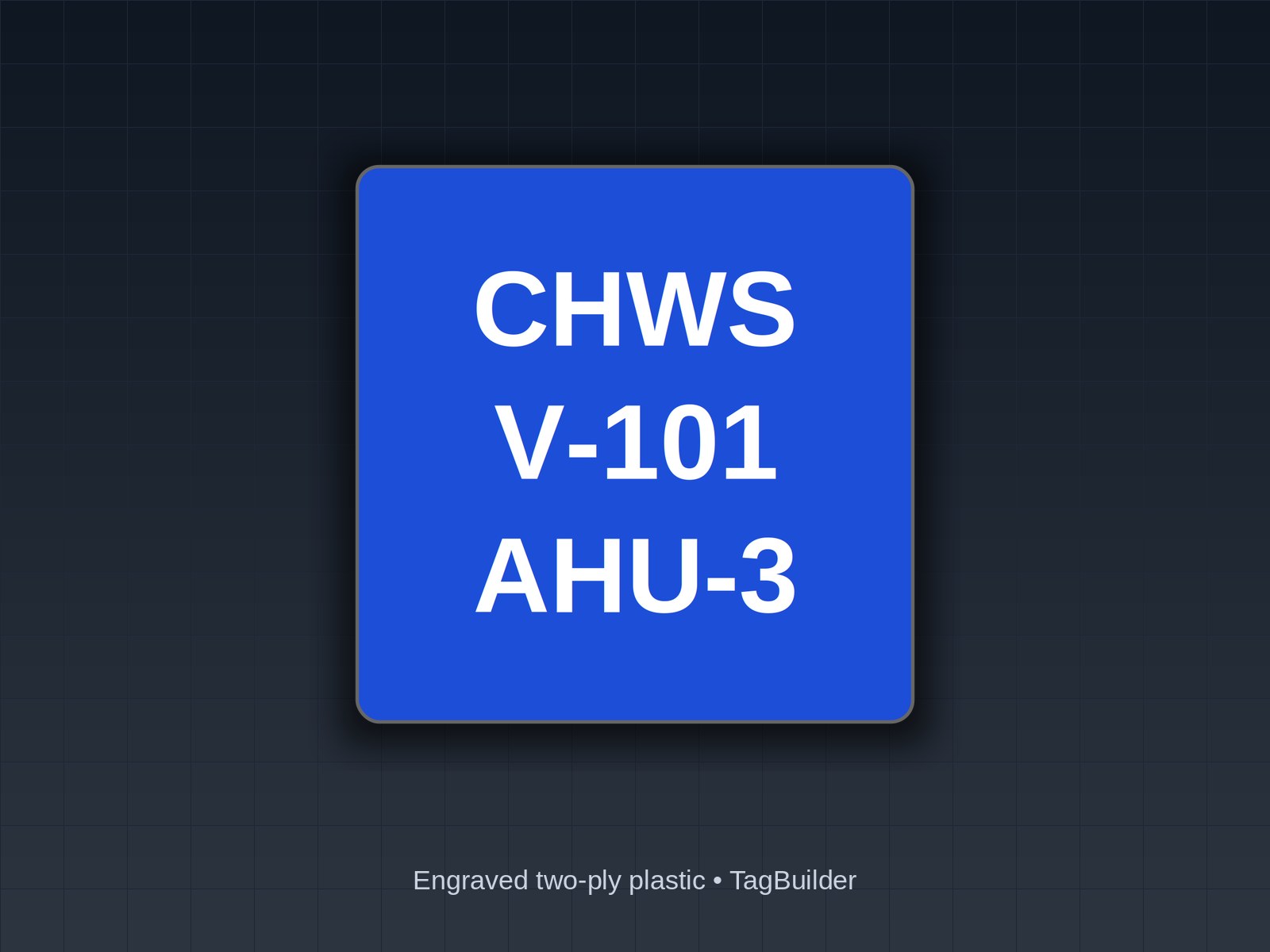
Under a simple sequential scheme, V-101 usually just means valve number 101 in installation order — the digits carry no location or system meaning on their own. In an area- or system-based format the same valve might instead read B1-CW-101, where the prefix adds building and system context.
Should valve numbers match the P&ID?
Where a formal P&ID exists, many facilities key the tag number to the same loop or line number shown on the drawing, often following ISA-5.1 conventions. This keeps field tags and engineering documents in agreement, which matters most in process plants where operators cross-reference drawings during troubleshooting.
How do I add a valve later without renumbering?
Leave gaps in the sequence when you first assign numbers — numbering by 5s or 10s is common — so a new valve can take an unused number near its neighbors. Some facilities also reserve a letter suffix, such as 101A, for a valve added close to an existing one.
What abbreviations are standard for HVAC valve tags?
There’s no single mandatory list, but common shorthand includes CW for chilled water, HW for hot water, STM for steam, CDA for compressed dry air, and DW for domestic water. Some facilities also draw on ISA-5.1 function letters such as XV for an on-off valve. Whatever you choose, document it.
Where do I record the valve list?
A spreadsheet works for smaller facilities; larger ones typically log each tag number in a CMMS alongside the valve’s location, system, and service history. Keeping the list current as valves are added, moved, or retired matters more than which tool holds it.
UL, NFPA, NEC, ASME, CEMA, TIA, ANSI and OSHA are names or marks of their respective organizations; TagBuilder is not affiliated with or endorsed by any of them. Requirements above are paraphrased summaries, not the text of any standard. Always work from the current published edition and your AHJ.